



- Stock:
- Model: C322.PLCXXX.TEC1-127
Peltier 12V 40W Thermoelectric Cooler Module TEC1-12706❄️
The TEC1-12706 is a high-quality thermoelectric cooler (Peltier) module designed for precise heating and cooling applications. Using the Peltier effect, it creates a temperature difference across its two ceramic faces to move heat from one side to the other. This makes it ideal for electronics cooling, temperature-controlled enclosures, portable refrigerators, and DIY projects with Arduino, Raspberry Pi, and other microcontroller-based systems.
⚙️ Key Features
- High efficiency: Converts electrical power into a strong temperature gradient for both cooling and heating.
- Compact design: Slim 40 x 40 mm footprint for easy integration into electronics modules and custom builds.
- Durable construction: Ceramic plates with semiconductor junctions for long-term reliability.
- Quiet operation: Solid-state device with no moving parts—ideal for noise-sensitive environments.
- Broad applicability: Suitable for CPU/GPU auxiliary cooling, lab setups, and temperature stabilization.
📐 Technical Specifications
- Model: TEC1-12706
- Maximum Voltage (Vmax): 15.4 V
- Optimal Operating Voltage: 12 V
- Maximum Current (Imax): 6 A
- Power Consumption: 40 W (at 12 V)
- Maximum Power Consumption: 92 W (at 15.4 V)
- Temperature Differential (ΔTmax): 68 °C
- Dimensions: 40 mm × 40 mm × 3.6 mm
- Weight: ~25 g
- Material: Ceramic plates with semiconductor elements
Note: Achieving ΔTmax requires optimal thermal management and adequate heat dissipation on the hot side. Real-world performance depends on load, heatsink capacity, and ambient conditions.
🧪 Typical Applications
- CPU and GPU cooling: Assists in maintaining lower component temperatures when paired with robust heatsinks.
- Climate-controlled containers: Keeps setpoints for food, beverages, or medical samples.
- Portable refrigerators: Compact, solid-state cooling for personal devices.
- Temperature-controlled enclosures: Stable thermal environments for experiments and sensors.
- DIY electronics projects: Popular with Arduino and Raspberry Pi users for learning thermal control and PID loops.
✅ Why Choose the TEC1-12706?
- High performance: Capable of generating a substantial temperature differential for efficient heat transfer.
- Reliability: Built from premium materials for consistent, dependable operation.
- Easy integration: Compact form factor suits many electronics components, modules, and custom assemblies.
- Low maintenance: Solid-state design with minimal upkeep needs.
{IMG_TAG_1}
🔧 Sample Circuit and Integration
Below is a basic setup for using the TEC1-12706 in a cooling application. For closed-loop control, pair it with a microcontroller (e.g., Arduino or Raspberry Pi) and a suitable driver.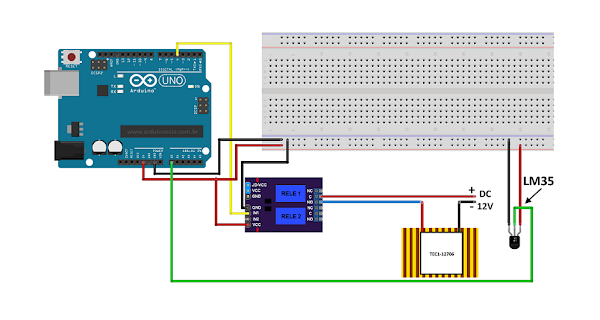
🔩 Components
- TEC1-12706 Peltier module
- Heatsink for the hot side (with adequate thermal capacity)
- Power supply: 12 V, 6 A (minimum), DC
- Thermal paste or thermal pad
- Fan (optional, improves hot-side dissipation)
- Temperature controller or microcontroller with PWM driver (e.g., MOSFET or H-bridge)
📘 Wiring and Setup
- Attach the heatsink: Apply thermal paste to the hot side and firmly mount a heatsink; add a fan for higher efficiency.
- Connect power: Supply 12 V DC capable of up to 6 A. Do not power directly from a microcontroller or USB.
- Polarity: One polarity cools side A and heats side B; reversing polarity swaps the effect.
- Control: Use a PWM-capable MOSFET or an H-bridge if you need to reverse heating/cooling. Implement a thermostat or PID loop via Arduino/Raspberry Pi for precise temperature control.
⚠️ Design Notes
- Heatsinking is critical: Insufficient hot-side cooling will drastically reduce performance and may damage the module.
- Do not exceed Vmax (15.4 V): Operate at 12 V nominal for best balance of performance and lifespan.
- Condensation risk: Cooling below dew point may cause moisture; consider insulation or conformal coatings where appropriate.
- Flat, even mounting: Avoid mechanical stress; do not over-tighten clamps.
📦 Package Contents
- 1 × TEC1-12706 Peltier Module