


- Stock:
- Model: T122.ACT5
3–12V Passive Buzzer with Wire–AT3040🔊
The AT3040 is a compact, passive buzzer designed for reliable sound indication in a wide range of electronics projects. Operating from 3–12 V DC (up to 30 V peak), it is ideal for Arduino, Raspberry Pi, and other microcontroller-based systems where a PWM or external oscillator drives the tone. With a small footprint (approx. Ø12 mm) and low current draw, it’s a versatile choice for alarms, appliances, and DIY modules.
✨ Key Features
- Passive design (requires PWM/external oscillator) ⚡ – No internal oscillator; drive with a PWM signal from a microcontroller or an external circuit (e.g., 555 timer).
- Wide frequency flexibility 🎶 – Output tone follows the input signal; commonly used from 1 kHz to 5 kHz.
- Compact and lightweight 🧩 – Small footprint (~12 mm diameter) for tight enclosures and modules.
- Energy efficient 🔋 – Typical current draw around 10–30 mA depending on signal and voltage.
- Pre-wired leads 🛠️ – Easy to integrate into breadboards, PCBs, and wiring harnesses.
⚙️ Technical Specifications
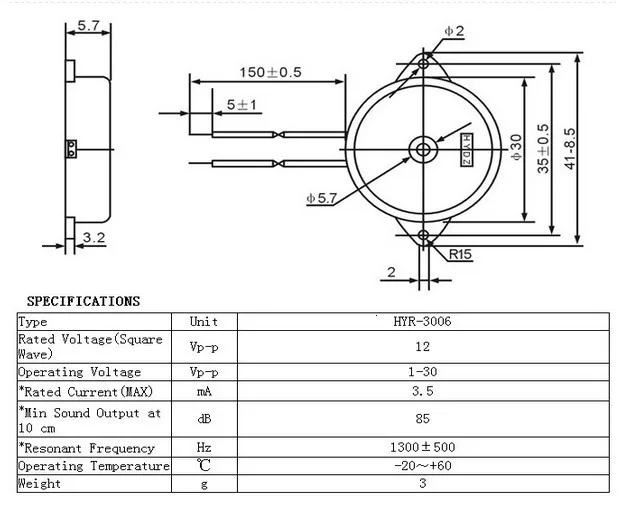
- Model: AT3040
- Type: Passive buzzer
- Dimensions: Approx. 12 mm diameter
- Operating Voltage: 3–12 V DC (up to 30 V peak)
- Frequency Range: Defined by driving signal; commonly 1–5 kHz
- Sound Pressure Level (SPL): ~85 dB @ 10 cm (varies with voltage, frequency, duty cycle)
- Current Consumption: Typically 10–30 mA, dependent on input signal
🧪 Typical Applications
- Electronic Projects: Audible alerts and tones in Arduino, Raspberry Pi, ESP32, and other microcontroller builds.
- Alarm Systems: Security and fault indication in DIY and commercial modules.
- Home Appliances: Status beeps in devices like washing machines and microwave ovens.
- Toys & Gadgets: Sound effects and signal tones in consumer electronics.
✅ Pros and ⚠️ Cons
Advantages
- Versatile sound generation: Produce varied tones by changing frequency and duty cycle.
- Cost-effective: Affordable and widely available electronics component.
- Compact and lightweight: Easy to fit into small enclosures and modules.
Disadvantages
- Requires external drive signal: Needs a PWM source or oscillator, adding minimal circuit complexity.
- Performance depends on input: Loudness and timbre vary with voltage, frequency, and duty cycle.
🔧 Integration Notes
- Drive method: Use a microcontroller PWM pin or an external oscillator (e.g., 555 timer).
- Current handling: If required current exceeds your MCU’s pin rating, drive the buzzer via an NPN transistor or logic-level MOSFET with a suitable series resistor.
- Polarity: Pre-wired leads typically follow red = +V, black = GND (verify before wiring).
- Tuning: For maximum loudness, sweep around 2–3 kHz and adjust duty cycle (~50% as a starting point).
🛠️ Example: Arduino Usage
Connect the AT3040 to a PWM-capable pin on your Arduino (or similar microcontroller). If your design requires higher current or voltage, use a transistor driver stage.
// Simple 1 kHz beep using Arduino int buzzerPin = 9; // PWM-capable pinvoid setup() { pinMode(buzzerPin, OUTPUT); }void loop() { tone(buzzerPin, 1000); // Generate a 1 kHz tone delay(1000); // On for 1 second noTone(buzzerPin); // Stop tone delay(1000); // Off for 1 second } 📦 Summary
The AT3040 passive buzzer is a reliable, 3–12 V, pre-wired sounder for Arduino, Raspberry Pi, and general electronics projects. Its external oscillator requirement enables broad frequency flexibility, making it a great fit for prototypes, alarms, appliances, and hobbyist modules while keeping power consumption low.