


- Stock: In Stock
- Model: T175.REED14-2P
14 mm Reed Switch NO 2‑Pin 🧲
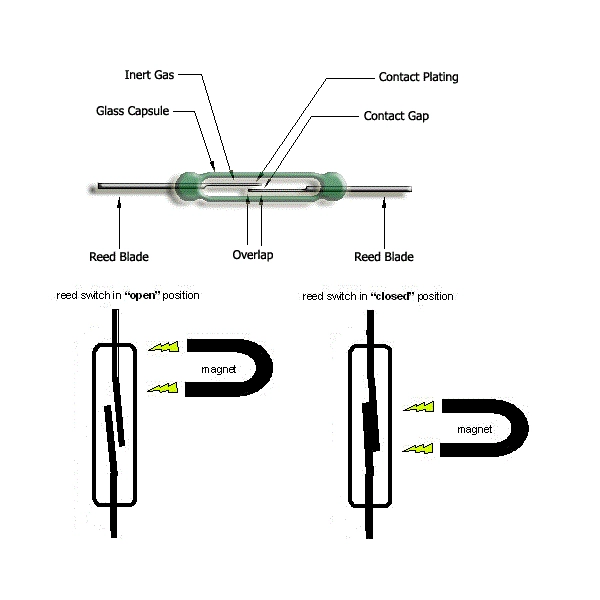
The 14 mm Reed Switch (Normally Open, 2‑pin) is a compact, glass‑encapsulated electromechanical switch designed for low voltage and low current applications. Inside the hermetically sealed glass tube are two ferromagnetic reeds that close in the presence of a magnetic field and open when the field is removed. This makes it ideal for sensor and position detection tasks in Arduino, Raspberry Pi, and other microcontroller projects, as well as industrial and automotive systems.
Key Features 🔧
- Magnetic operation: Contacts close when a magnet is near and open when it’s removed, providing reliable, contactless actuation.
- Normally Open (NO): This model is NO; the circuit closes on magnetic activation. Other reed types include NC and SPDT (changeover).
- Hermetically sealed: The glass envelope protects contacts from dust, moisture, and contaminants for enhanced durability and stability.
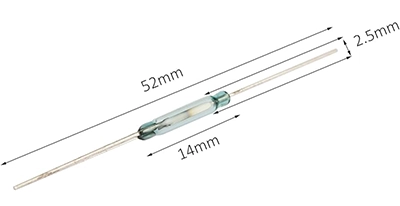
- Compact form factor: Slim 2 mm diameter and 14 mm length suit space‑constrained electronics modules and embedded systems.
Technical Specifications 📐
- Switch Type: Normally Open (NO), 2‑pin
- Voltage Range: 3.3 V ~ 24 V DC
- Maximum Operating Current: 1.2 A
- Max Switching Frequency: 100 Hz
- Mechanical & Electrical Life: ≈ 100,000 operations
- Contact Resistance: 20 mΩ
- Insulation Resistance: 100 MΩ
- Operating Temperature: −50 to +140 °C
- Length: 14 mm
- Glass Diameter: 2 mm
- Approximate Weight: 1 g
Applications 🚀
- Sensor systems: Door/window alarm sensors, bicycle speedometers, proximity and presence detection.
- Electronic devices: Keyboards, household appliances, medical devices, and general electronics components and modules.
- Automotive: Door/hood/seat‑belt position sensing and motion detection in vehicles.
- Industrial automation: Position, limit, and movement detection on machinery and equipment.
Advantages ✅
- Electrical isolation: Hermetic sealing improves reliability in harsh environments.
- Low power consumption: Magnetically actuated with negligible quiescent power.
- Long lifespan: Minimal contact wear and no continuous coil power required.
- High-speed switching: Millisecond response suitable for rapid sensing up to the specified frequency.
Limitations ⚠️
- Magnetic interference: Nearby magnetic fields may cause unintended switching; consider shielding and placement.
- Fragility: Glass body can break under mechanical stress; handle and mount carefully.
- Current capacity: Not intended for high‑current power switching; use a relay or transistor driver if needed.
Example Connection with Arduino 💡
Use the reed switch as a digital input to control an LED or trigger events. The example below uses the internal pull‑up resistor for a stable input. Connect one reed lead to GND and the other to digital pin 2. The LED uses LED_BUILTIN (on many Arduino boards). For Raspberry Pi or 3.3 V microcontrollers, use a GPIO with a pull‑up and observe 3.3 V logic.
// Reed switch example with internal pull-up int reedPin = 2; // Reed switch to D2 (other lead to GND) int ledPin = LED_BUILTIN; // On-board LED (or use a pin with a series resistor)void setup() { pinMode(reedPin, INPUT_PULLUP); // Input with pull-up; closed = LOW pinMode(ledPin, OUTPUT); }void loop() { bool closed = (digitalRead(reedPin) == LOW); // LOW when magnet closes the switch digitalWrite(ledPin, closed ? HIGH : LOW); } Tip: For noisy environments or very fast events, consider software debouncing or a small RC filter across the input.Summary 📦
The 14 mm NO Reed Switch is a reliable, compact, and cost‑effective choice for low‑voltage, low‑current switching in Arduino, Raspberry Pi, and embedded designs. With hermetic sealing, low contact resistance, and wide operating temperature range, it’s well‑suited for sensor, automation, and position detection applications across consumer, automotive, and industrial sectors.