


- Stock: In Stock
- Model: A0287.MQ8
MQ-8 Hydrogen Gas Sensor Module 🔍⚗️
The MQ-8 Hydrogen Gas Sensor is a reliable, high-sensitivity chemiresistive sensor designed to detect hydrogen (H₂) in ambient air. Ideal for industrial monitoring, gas leak detection, environmental sensing, and embedded systems, it integrates seamlessly with Arduino, Raspberry Pi, and other microcontroller-based projects. This sensor delivers fast response and stable performance across a wide operating range—perfect for both electronics engineers and hobbyists.
Key Features ⭐
- 🔬 High sensitivity to hydrogen (H₂) for accurate, repeatable detection.
- 📈 Wide detection range: 100–10,000 ppm for versatile applications.
- 🛡️ Long lifespan and robust construction for dependable, long-term use.
- 🧩 Easy to interface with common microcontrollers, including Arduino and Raspberry Pi.
- ⚡ Fast response time for rapid leak indication and real-time monitoring.
Technical Specifications ⚙️
- Operating voltage: 5 V
- Detection range: 100–10,000 ppm (H₂)
- Operating temperature: −20 °C to +50 °C
- Humidity: up to 95% RH
- Response time: < 1 s
- Heating resistance: 31 Ω ± 3 Ω (heater coil)
- Heater current (typ.): ≈ 160 mA at 5 V (derived from heater resistance)
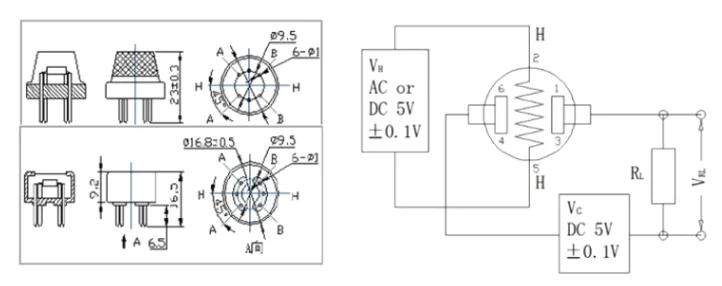
How It Works 🧠
The MQ-8 is a chemiresistive sensor whose internal sensing element changes resistance in the presence of hydrogen gas. With a suitable load resistor (RL), the sensor forms a voltage divider that produces an analog voltage proportional to gas concentration. Many breakout modules also include a comparator for adjustable digital (DO) threshold output, alongside the analog (AO) signal.
Typical Interface with Arduino / Raspberry Pi 🛠️
- Provide a stable 5 V supply for the heater and sensor circuitry.
- Use an appropriate load resistor (RL) (typ. ~10 kΩ) to read the analog output via an ADC (native on Arduino; use an external ADC for Raspberry Pi).
- If your module has a DO pin, set the onboard potentiometer to the desired threshold for digital alerts.
- Allow a warm-up/preheat period for best stability; perform calibration in clean air to determine R₀ and normalize readings.
Potential Applications 🚀
- Industrial hydrogen detection
- Residential safety systems
- Environmental monitoring
- Gas leak detection in pipelines
- Hydrogen fuel cell monitoring
- STEM education, prototyping, and DIY electronics components projects
Notes and Best Practices 📌
- Calibration is required for quantitative measurements; sensor output is influenced by temperature and humidity.
- The MQ-8 exhibits some cross-sensitivity to other gases; verify selectivity for your application.
- Not a certified safety device: use in non-safety-critical applications or alongside approved safety systems.
- Operate in well-ventilated, non-condensing environments to ensure consistent readings and sensor longevity.
Whether you are integrating hydrogen sensing into an industrial control system or building a prototype with Arduino or Raspberry Pi, the MQ-8 hydrogen sensor module delivers dependable performance, straightforward interfacing, and excellent value for modern electronics modules and microcontroller applications.