


- Stock: In Stock
- Model: A0286.REED14MM3P
14 mm Reed Switch, NO/NC, 3‑Pin (SPDT) 🧲
The 14 mm reed switch is an electromechanical sensor and switching component that uses a magnetic field to open or close its contacts. Inside the hermetically sealed glass tube are two ferromagnetic reeds that move together (close) or apart (open) when exposed to a magnet. This 3‑pin version provides a changeover (SPDT) contact with Common, Normally Open (NO), and Normally Closed (NC) terminals—ideal for low voltage and low-current control circuits in Arduino, Raspberry Pi, and other microcontroller projects.
Key Features ⚙️
- Magnetic actuation: Contacts switch in response to an external magnetic field; remove the field to return to the default state.
- NO/NC changeover (SPDT): Three pins provide Common, NO, and NC for flexible logic and signal routing.
- Hermetically sealed glass: Protects the reeds from dust, moisture, and contaminants for high reliability in harsh environments.
- Compact 14 mm form factor: Small and lightweight; easy to integrate into sensors, modules, and enclosures.
- Fast, low-power switching: Magnetic operation enables low power consumption and millisecond-class response times.
Technical Specifications ⚡📐
- Contact configuration: SPDT (Changeover) — 3 pins: COM, NO, NC
- Typical operating voltage/current (usage context): 5 V–12 V DC systems, handling currents from 0.5 A to 2 A in low-power circuits
- Operating temperature: −40°C to +125°C
- Response time: Typically in the milliseconds range
- Encapsulation: Glass tube (approx. 14 mm length)
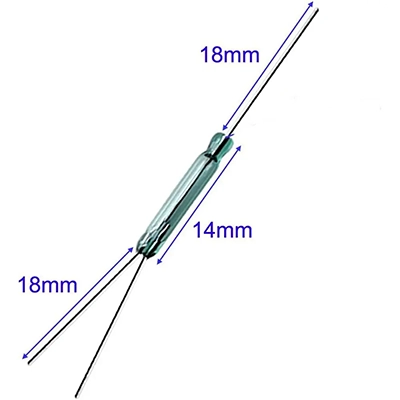
Note: Ratings vary by manufacturer. Always verify the exact contact ratings and derating curves in the component’s datasheet for your application.
Pinout 🔌
- COM (Common): Switching common terminal
- NO (Normally Open): Closes to COM when a magnetic field is applied
- NC (Normally Closed): Opens from COM when a magnetic field is applied
Applications 🧭
- Sensor systems: Door/window magnetic sensors, bicycle speedometers, presence detection
- Electronic devices: Keyboards, appliances, medical devices, and general electronics components modules
- Automotive: Position detection for doors, seat belts, and moving parts
- Industrial automation: Position, limit, and movement sensing on machinery
Advantages ✅
- Electrical isolation: Sealed glass envelope isolates contacts from the environment for high reliability
- Low power operation: No coil or drive electronics required for the switch element itself
- Long service life: Minimal contact wear due to sealed, frictionless actuation and short contact travel
- High-speed switching: Millisecond response suitable for many control and sensing tasks
Limitations ⚠️
- Magnetic interference: Nearby magnets or strong fields may cause unintended switching
- Fragile glass body: Handle with care to avoid breakage
- Limited current capacity: Not intended for high-current loads; use to drive logic-level inputs or via a relay/transistor
Example: Arduino LED Indicator 💡
Connect the COM pin to GND and the NO pin to a digital input with an internal pull-up. When a magnet is present, the input goes LOW. The example below turns an LED ON when the reed switch is activated.
// Pins const int reedPin = 2; // Reed switch to D2 (NO to D2, COM to GND) const int ledPin = 13; // Onboard LEDvoid setup() { pinMode(reedPin, INPUT_PULLUP); // Use internal pull-up to avoid floating input pinMode(ledPin, OUTPUT); }void loop() { int active = (digitalRead(reedPin) == LOW); // LOW when magnet closes NO->COM digitalWrite(ledPin, active ? HIGH : LOW); } Tip: For Raspberry Pi (3.3 V GPIO), use an internal pull-up on the input pin and wire NO to the GPIO and COM to GND. Consider debouncing in software if you see chatter.
Integration Notes 🛠️
- Use series resistors and protection as needed; avoid switching high inrush or inductive loads directly.
- Place the sensor away from strong stray magnetic fields and ferrous materials that could affect sensitivity.
- Mount securely to minimize vibration; consider heatshrink or a sleeve to protect the glass capsule.
Why Choose This Reed Switch 🎯
This 3‑pin SPDT reed switch offers reliable, low-power, and compact magnetic switching for Arduino, Raspberry Pi, and other microcontroller projects. It’s a versatile choice for DIY makers and professional engineers building sensors, counters, and position-detection modules in low-voltage systems.